

4 July 2023
Scion scientists have embarked on important new research to find out how much methane is being consumed by microorganisms in New Zealand’s planted forest soils.
Forest soils are good habitats for bacteria that absorb and release methane (CH4) as a source of carbon and energy. By quantifying how much methane is consumed by the bacteria, known as methanotrophs, at field sites, the project will reveal just how important planted forest soils are to New Zealand as part of broader efforts that seek to better understand the country’s total net emissions and ways to mitigate climate change.
Once complete, the research will provide valuable insights for policy makers examining greenhouse gas emissions as it can be used to paint a more accurate picture of the country’s total net carbon budget.
Due to agricultural activity, methane production in New Zealand is disproportionately high on a per capita basis – about six times the global average. Understanding the potential for other land uses, such as forestry, to mitigate these agricultural emissions is critical, says Scion senior scientist Dr Steve A. Wakelin.
“We know that forests are great for storing carbon from carbon dioxide, but this research is helping us learn about forestry’s capability to offset methane emissions as well. We believe it is a first step in a future programme of work that will demonstrate how different land uses in New Zealand are all interconnected, and how to manage these holistically for win-win outcomes.”
He says New Zealand’s economy is reliant on the livestock sector for jobs, food and income. Scion’s research aims to show how forestry can support the agricultural sector to tackle one of its biggest challenges.
The Ministry for Primary Industries is funding the research, with support from Lincoln University. It follows international studies proving that forest soils create optimal conditions for the methane-absorbing microbes. As methane in the air passes over and diffuses within forest soil, methanotrophs consume the methane.
“We find methanotrophs are abundant in our DNA-based surveys of planted forest soils,” Wakelin says. “Indeed, based on overseas systems, it turns out that planted forest soils are pretty good habitats for methanotrophs; we just haven’t looked at this in New Zealand before.”
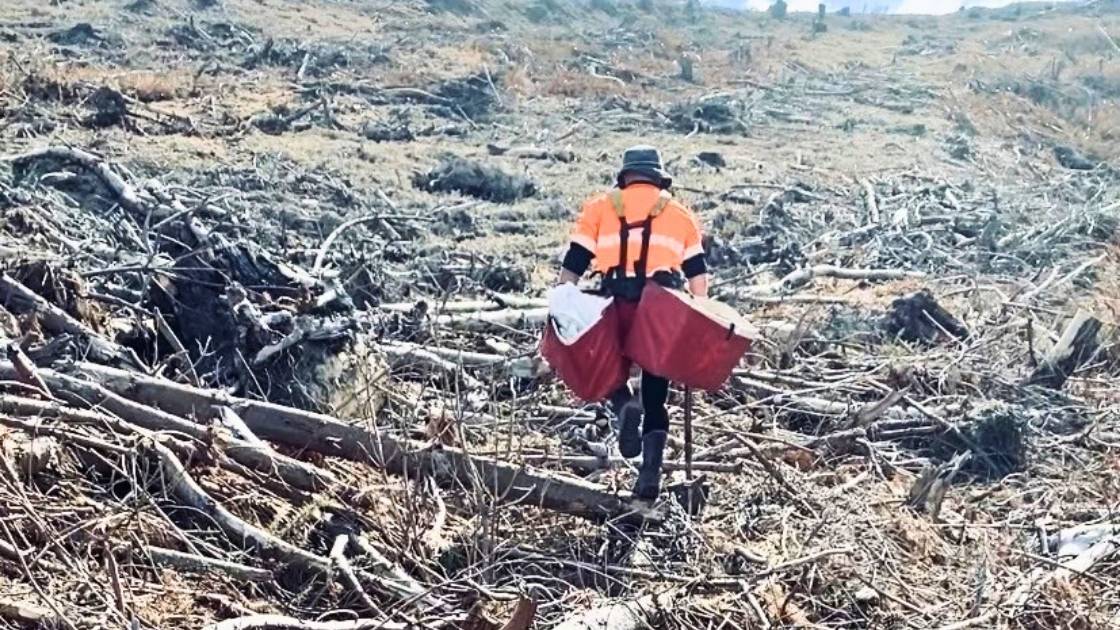
Photo: Scientist and project lead Kathryn Walker is measuring how fast soil microbes are consuming methane by taking gas samples from field chambers installed in forests
Source: Scion
More Posts

10 Nov 2026
ForestTECH 2027 programmes released: AI, autonomous systems, & precision silviculture
Innovatek has officially released the full conference programmes for ForestTECH 2027, Australasia’s premier event series dedicated to forest resource management, remote sensing, GIS, precision silviculture, and operational technology. Celebrating its 20th year, the 2027 series will run on 9-10 March ...
Read more

10 Nov 2026
Drone project to tackle wasps and hornet nests takes flight
The Bioeconomy Science Institute Maiangi Taiao is exploring cost-effective drone systems to make nest removal safer, faster and easier in high-risk locations, such as tall trees, cliff faces, and steep gullies. The project, funded by Better Border Biosecurity (B3), begins ...
Read more

10 Nov 2026
Finland’s forest database expands to cover 8.5 billion trees – one of the largest in the world
The forest database, which began as a research experiment, now includes data on 8.5 billion trees over an area of 29 million hectares. The database, which has grown to cover almost all of Finland, is a demonstration that at-scale production ...
Read more

10 Nov 2026
New program to strengthen forest certification and auditing capability
A new training program aims to strengthen auditing capability across the forestry sector in Australia and New Zealand, helping forestry businesses build the expertise to navigate certification requirements, while expanding the pool of specialist auditors equipped to assess forest management practices ...
Read more
12 Oct 2026
Can exoskeletons ease silviculture work?
Pruning and planting are among the most physically demanding tasks in forestry. Workers spend long hours undertaking repetitive movements, working with their arms elevated, handling loads, and navigating challenging terrain. While these activities are fundamental to establishing and maintaining productive ...
Read more

12 Oct 2026
Global sustainability progress report
The International Council of Forest and Paper Associations (ICFPA) released its biennial Sustainability Progress Report which demonstrates progress in seven key areas of sustainability. The 2026 report also highlights the role the forest products sector can play in helping meet ...
Read more

12 Oct 2026
Study shows forest soils help offset methane emissions
Run over two years, the research looked at the methane uptake of soils in three planted forests – Orton Bradley Park and McLeans Island in Canterbury and Kaingaroa (New Zealand’s largest commercial pine plantation, in the Bay of Plenty) – ...
Read more

12 Oct 2026
Faster wood formation matters more than longer growing seasons in a warming climate
In non-tropical forests, cold winters hinder tree growth. There, climate warming prolongs the period during which trees absorb carbon through photosynthesis and store it in wood, known as the growing season. This could potentially mitigate further climate change as wood ...
Read more

07 Sep 2026
Beyond Woodchips: Australia’s hardwood plantation industry must innovate
For more than three decades, Australia’s hardwood plantation industry has been built on a simple but largely successful business model: growing world-class plantation fibre for export to Asia’s pulp mills. It has underpinned regional economies, attracted significant investment and established ...
Read more

07 Sep 2026
Free program to help SMEs advance AI and digital tech ideas in Queensland
The free eight-week online program, delivered by Australia’s national science agency, CSIRO, helps businesses turn early-stage ideas into actionable R&D plans while building connections with expert facilitators and researchers. Offered through the Queensland Government-funded Regional University Industry Collaboration (RUIC) program, ...
Read more

07 Sep 2026
Science safeguards NZ’s rarest ecosystems
Some of New Zealand’s most remarkable ecosystems are also among its rarest. Now, new research is aimed at helping councils and land managers better understand and protect them. Led by the Bioeconomy Science Institute Maiangi Taiao, the two-year project will develop practical ...
Read more

07 Sep 2026
AI identifies trees from the air as accurately as the human eye
A new remote sensing method identifies the species of individual trees with an accuracy of up to 90 percent. Detailed data on species makes forestry more efficient and improves the monitoring of biodiversity. Thanks to recent research on tree species ...
Read more

07 Sep 2026
Learning Through the Storm: Report released
The Top of the South Wood Council, with support from Te Uru Rākau – New Zealand Forest Service, has recently released Learning Through the Storm, a report on the widespread windthrow caused by the severe storm events of 2025. On July ...
Read more

04 Sep 2026
Carbon Forestry 2026 – Event Summary
The Carbon Forestry 2026 Conference, held in Rotorua on 4–5 August, brought together forest managers, investors, industry leaders and government representatives to explore some of the big questions facing carbon forestry. The Government’s commitment to forestry was reinforced by Climate ...
Read more

11 Aug 2026
Forestry confirms new training partnership with Competenz
New Zealand’s forestry sector has confirmed it will align its workplace vocational training with the new Engineering and Manufacturing Private Training Establishment (PTE), operating under Competenz. The decision follows extensive consultation with employers, contractors and training providers, led by the ...
Read more

11 Aug 2026
FPInnovations launch new forest seeding by drone trial
In the wake of wildfires, bringing affected areas back into production poses a major challenge, particularly in remote or hard-to-reach areas. In Canada, wildfires affect an average of 2.8 million hectares of forest each year, underscoring the importance of exploring innovative ...
Read more

11 Aug 2026
Extracting knowledge from a forest 3d digital twin using TreeTools SilvaCloud
Modern LiDAR technology is transforming the way we understand forests. With the introduction of sensors such as the DJI Zenmuse L3, collecting detailed three-dimensional information about forest structure, terrain, and vegetation has become more accessible than ever before. At Interpine, ...
Read more

11 Aug 2026
Opportunities for improved firefighter safety in Australia
John O’Donnell Opinion Piece Firefighter safety in Australia requires urgent attention as forest structure, fuel loads and fire behaviour shift toward more dangerous conditions. Past crown fires have created dense shrub dominated understoreys, abundant dead wood, reduced height stratification and ...
Read more

11 Aug 2026
Annual reputation survey provides insight into public perceptions of forestry
The results of the Forest Growers Levy Trust’s 7th annual Social Licence to Operate (SLO) survey have been published, continuing to build one of the sector’s most valuable long-term evidence bases for understanding how New Zealanders view forestry. After 7 years ...
Read more

11 Aug 2026
Revisiting a forest experiment that lay forgotten for 30 years
What’s the best way to manage a forest? Australians have argued about this for decades. The debate is often framed as binary: do we protect forests entirely, or harvest trees to support local economies and communities? The reality is more ...
Read more

07 Jul 2026
Hexagon acquires ITRES to expand the scope of airborne mapping
Hexagon has acquired ITRES, the Calgary-based provider of high-performance airborne hyperspectral and thermal imaging systems, strengthening its ability to deliver richer multi-sensor geospatial data for advanced airborne mapping and analysis. The acquisition unites two complementary portfolios under one provider. Hexagon ...
Read more